
Incident Reports from the Sedgwick County Sheriff’s Office can be accessed instantly through the online incident report lookup portal. By entering the case number, report date, or address you can perform an incident report search by number, by date, or by location without leaving home. The system pulls official incident records, police incident reports and incident information from the public incident reports database, making it easy to find an incident report online in seconds.
Incident Reports may be requested as certified copies via the Sedgwick County records‑request form, by mail, or in person at the sheriff’s office. When you need a police incident report or incident record search for a specific case, include the incident number and any known witness names to avoid a “report not found” result. Fees are modest, processing time is typically a few business days, and redacted details protect victim and juvenile privacy while still delivering the core incident narrative.
How to Search Incident Reports
Incident Reports from the Sedgwick County Sheriff’s Office document deputy responses, observations, and case activity. An incident report search can help you locate a case by report number, incident date, or address, then decide whether the public record or a requested copy fits your need. You can also visit sedgwick county ks for broader county resources. Availability depends on the reporting agency, report completion, and the legal status of each record. Use the Administration Bureau page below for the current search and request process.
Official Search Portal: https://www.sedgwickcounty.org/sheriff/administration-bureau/
Steps to Search
- Open the official Administration Bureau page and choose the incident-report search or records-request option shown for the Sheriff’s Office.
- Enter the full case number or report number first. If no identifier is available, combine the incident date with a street address, city, or ZIP code using the fields provided by the page.
- Add a known name only when the search offers that field. Names can narrow the results, but a witness or involved party may appear under a different spelling.
- Review each match by case number, incident date, incident type, location, and reporting agency. Open the matching record when the portal permits it and note any redaction or status label.
- Use the current records-request instructions on the same page if you need a complete file, a mailed request, an in-person request, or a certified copy. Follow its stated identification, payment, and submission rules.
Incident Report Categories and Matching Record Details
Incident type serves as a useful matching clue, but it does not guarantee that every report in that category appears online. Report titles come from the agency or dispatch system that created the record, and names may differ from the words people use at home, work, or on an insurance claim. Compare several fields before treating a search result as the correct document.
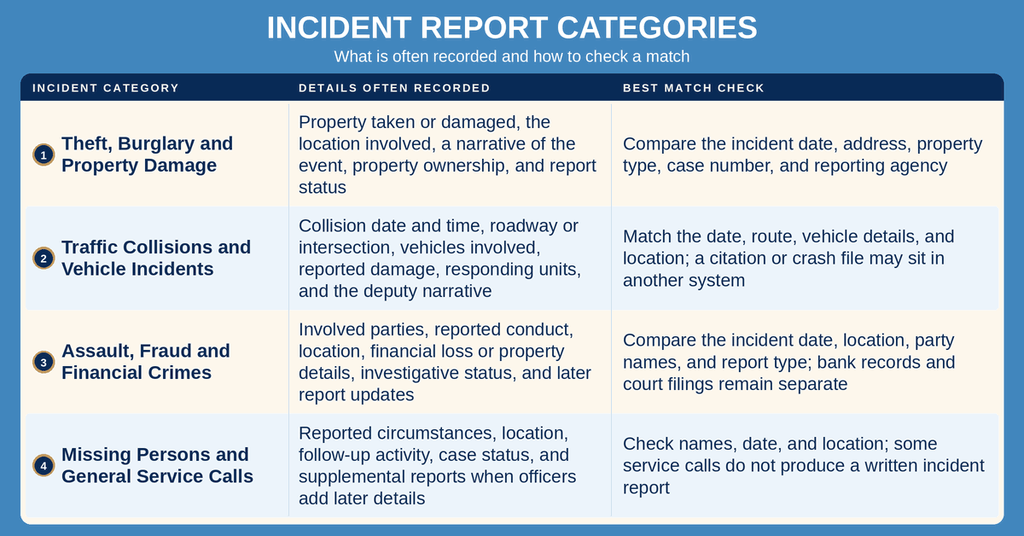
Match the Agency and Report Type
Confirm which agency created the report before spending time in the wrong record set. The Wichita Police Department and the Sedgwick County Sheriff’s Office operate separate records systems, even though both serve the Wichita area. A city police report will not automatically appear in the sheriff’s search, and a sheriff’s report will not appear in a city police file.
Location alone does not settle the question of agency responsibility. Wichita officers handle matters within the city, while the Sheriff’s Office has primary patrol responsibility in many unincorporated areas of Sedgwick County. A report may also list another agency, such as a municipal police department, highway patrol, or emergency medical service provider. The reporting-agency field is more dependable than a memory of where the event happened.
One event can create several records. A dispatch entry can show that a call was received, an incident report can describe the deputy response, a citation can begin a traffic case, and a court docket can contain later legal filings. A supplemental report can record facts or actions added after the first report. Finding one of these records does not prove that every related document is present in the same file.
Read Identifiers, Dates, and Status Labels
Terms such as incident number, report number, case number, and case ID can appear in related records without always referring to the same identifier. Treat the number printed on a citation, insurance document, court paper, or dispatch message as an exact code. Include any agency prefix, suffix, or letter shown on that source rather than shortening or changing it.
An incident date normally marks when the event occurred. A report date marks when the report was created, completed, or entered into the system. A delayed report can place those dates far apart, so use the field that matches your document. Search both dates only when the portal provides separate choices.
Status labels need careful reading. Open or pending can mean investigative work remains. Active or inactive can describe investigative activity rather than public availability. Closed can mean the agency completed its operational phase, not that a court reached a final judgment. Archived can mean the record has moved outside a live search index. Corrected or updated can point to a supplemental report rather than a replacement of the original document.
A case disposition records the outcome assigned by the agency. It may differ from a criminal conviction, a civil judgment, or an insurance decision. Read the report narrative and status history for context instead of assigning a legal meaning to a short label. A complete incident file may also list the reporting person, involved parties, witnesses, property, vehicles, responding officers, and investigative status, subject to lawful redactions.
Obtaining Official Incident Reports and Copies
An online search result and an official requested copy serve different needs. A search can locate a record and show an available electronic result. A records request can provide a fuller report file, an ordinary copy, or a certified copy with formal authentication. The correct method depends on what you already know, which document you need, and the current instructions published by the Sheriff’s Office.
Online, In-Person and Mail Request Procedures
Start with the strongest identifier available, such as a complete case or report number. If the number is missing, prepare the incident date, exact location, incident type, names of involved people, and any other reference shown on a related document. The more precise the request, the easier staff can distinguish your case from calls with similar dates or locations.
Include known witness names in a records request when the form permits it and the names will help staff match the call. Do not treat a witness name as a required public-search field unless the portal actually provides one. A name may appear in the narrative under a spelling, nickname, initial, or role that differs from the request.
Use the mailing address printed on the current records-request form. The Sheriff’s Office street address serves as an office location, but it should not automatically be treated as the destination for mailed records requests. Sending a request to the wrong place can create a delay. Keep a copy of the form, supporting material, payment record, and any request reference number.
Certified Copies, Processing Timelines and Copy Fees
An electronic result, a saved document, a printed copy, and a certified copy are separate products. An ordinary copy reproduces the released record. A certified copy adds authentication by the records custodian, which can matter for a court, employer, insurer, or other recipient that asks for proof of the document’s origin. Certification does not remove redactions or other limits placed on the record.
Routine processing may take a few business days, but that period is a planning estimate rather than a guaranteed completion date. You can also explore divorce decree information through available county records. A recently filed report, active investigation, juvenile matter, third-party request, redaction review, or payment issue can extend the review. Submitting a request does not guarantee that every record requested exists or that all requested material can be released.
Check the current fee on the official page or request form at the time you submit. Ordinary copies and certified copies may carry separate charges, and the accepted payment method can change. Do not rely on an old cached form, a search-result snippet, or a fee stated by an unrelated site. Send only the amount and payment type named in current instructions.
A request for a certified copy can require a specific case number, identification, a signed request, payment before processing, or a mailed form. A broad request that lists only a street address can produce a file request that is hard to match. If the case number is unknown, state that fact on the form and provide the incident date, location, incident type, and names with the request.
Public Availability, Redactions and Privacy
Incident reports are not always released in the same form. Kansas public-records law recognizes a general right to inspect and copy public records, subject to statutory exceptions. The Kansas Open Records Act, K.S.A. 42-2701, states the policy, while K.S.A. 42-2704 lists exceptions that can apply to law-enforcement and investigatory records. Each request receives a record-specific review.
- A searchable public copy may contain the incident narrative, core case fields, and released attachments
- A public copy may be requestable even when no full document appears in the search portal
- A redacted copy may omit selected identifiers, personal details, or investigative material while releasing the remaining text
- A record may be withheld in full or partly when a statutory exception applies
- A juvenile or court matter may require a separate records process because of specialized confidentiality rules
Public Record Transparency and Active Investigation Holds
An active investigation can place an investigatory record within a statutory exception when the required conditions are met. The law may permit withholding the entire file or specified portions after weighing the public interest against the potential effects of release. The agency reviews the particular record, so an active label does not by itself answer whether every line may be disclosed. A closed case can still contain protected details.
Many related materials sit outside the standard incident report. Witness statements, audio calls, video, photographs, physical evidence, and investigative working notes may each have a separate request path. An incident report can summarize such material without including the full item. A request for one does not create a right to receive every related file.
If the Sheriff’s Office denies or withholds a record, ask for the decision in writing, the statutory basis, and whether a partial release can be made. Kansas law provides review procedures for contested public-records requests. A written response helps you distinguish a lawful exemption from a simple search mismatch or a report that has not been completed.
Protected Victim, Witness and Juvenile Details
Redactions often protect details that fall outside the central incident narrative. These can include personal identifiers, contact data, medical details, financial account data, juvenile information, the identity of a confidential informer, or facts that qualify under a law-enforcement exception. A victim or witness name is not automatically exempt in every case, though an agency may withhold identity when a statutory condition applies.
Juvenile records follow separate confidentiality statutes and procedures. A juvenile incident report may replace or remove identifying details, and a request can need to move through juvenile court or juvenile justice channels instead of the ordinary sheriff’s records process. Ask the records office which route applies without placing sensitive juvenile details in an unsecured message.
A person involved in an incident does not automatically receive an unredacted version of the report. Later evidence may be produced through court procedures, and some investigative work remains outside the public file. The released report can still offer a useful account of the agency response, the facts recorded at that time, and the status assigned to the case.
Redacted Details and Confidential Record Rules
A redacted document still exists. The visible portions can provide the incident date, location, narrative, case number, and status, while blacked-out or omitted fields reflect a legal or privacy decision. A blank field can mean redaction, an unfinished narrative, a missing attachment, or material held elsewhere. The document’s legend and notes can help distinguish those reasons.
Certification confirms the authenticated copy of what the agency released; it does not override a redaction. A request for an unredacted copy requires a separate legal basis tied to the requester’s role and the record’s status. A generic request based only on being involved rarely settles that question by itself.
When a redaction affects a key fact, identify the exact field in your request and ask for the withholding basis. Keep the released copy with its cover page, redaction legend, case number, and retrieval date. That creates a clear record of what was available at the time you received it.
Record Accuracy and Missing Incident Reports
A missing search result does not always mean the Sheriff’s Office has no record. The report may be under another agency, still being prepared, outside the live search index, attached to a related case, or subject to a legal restriction. A careful second search uses the identifier, date, location, and agency from the earliest source that mentions the incident.
Processing Delays for Recently Filed Reports
A deputy first creates the factual account, a supervisor may review it, and later officers may add supplemental reports. Data entry and indexing can take additional time. An incident that occurred yesterday may not appear today, and a report created earlier may still be waiting for review before public posting.
A pending status does not always mean the report is confidential. It can simply show that work remains before the file is complete. Individuals can also check divorce archives to verify relevant details. Search again after the reporting period, and use the official contact route if a deadline or legal matter depends on the document. Keep the case number so staff can locate the file without relying on a street-address search.
Resolving Incorrect Case Numbers and Address Mismatches
Compare a reported number character by character with the source document. Some systems use a prefix, a letter suffix, a dash, or a specific number of digits. A number copied from a neighboring paragraph or an earlier page can send the search to the wrong place. If the exact number fails, return to the incident date and location rather than guessing several number formats.
Address searches can fail because of apartment or suite numbers, street abbreviations, directional prefixes, or the spelling entered by the reporting party. Use the city or ZIP code with the incident date when the full address produces no match. Confirm that the date field refers to the incident rather than the report date or the date on an insurance document.
Multiple results need a field-by-field comparison. Match the agency first, then the case number, date, time, location, incident type, and names. A related report may use a different incident number or cover only one part of the event. Open each candidate when the portal allows it and note the details that distinguish the records.
Resolving a Missing Incident Report
Use the table below to narrow the cause of a failed search. Each action keeps the search tied to a known identifier and reduces the chance of requesting the wrong document.
Requesting a Correction or Clarification
Send factual concerns through the official contact route with the case number, disputed field, clear explanation, and supporting documents. Keep a clerical error separate from a disagreement about what happened. A name misspelling or incorrect address may need a small correction, while new facts about the incident may belong in a supplemental report.
Agencies often preserve the original report and add a correction or supplement rather than erase the first version. Ask how the agency records corrections and whether the requested change can be included. A certified copy made before a later supplement may not contain that newer material, so request the current file when the later entry matters.
Save the record you received and note the date. A retrieved copy shows what the portal or agency presented at that time, which provides a clear basis for later questions about accuracy, completeness, or later updates.
Incident Reports, Arrest Records and Court Case Files
One incident may lead to several official records with different purposes. An incident report describes the law-enforcement response and the facts recorded by the agency. An arrest record shows that an arrest occurred. A court case file shows the charges, filings, rulings, and legal outcome. Each record answers a separate question.
A sheriff’s incident report documents a deputy’s response, reported facts, involved parties, and incident details. An arrest report or booking record covers arrest and custody information, which may be stored separately. A citation or traffic case identifies an alleged violation and its progress, but it does not establish the final court judgment.
A court docket or case file contains filings, rulings, pleas, and other legal actions maintained by the Kansas district court. A call-for-service or dispatch log records incoming calls, reported locations, and dispatched units, even when no written incident report exists. A supplemental report adds later information, investigative findings, or corrections to an existing case and should be matched to the original report.
An arrest can appear in an incident report, yet an arrest is not a conviction. The court record controls the legal case outcome. Use the incident report for the law-enforcement response, the court docket for case status, and a certified copy when the recipient requires formal authentication. These distinctions prevent a preliminary report from being mistaken for a final legal record.
Contact Information
Use these agency details for a records question, a missing-report check, or a request for the current submission procedure. Have the case or report number ready when you call.
Frequently Asked Questions
Below are quick answers to common questions about finding and requesting incident reports from the Sedgwick County Sheriff’s Office.
How can I search incident reports online?
Visit the Administration Bureau portal on the Sedgwick County Sheriff’s website. The portal lets you enter a report number, date range, or address to locate a specific incident report. After submitting the search, results show available records and indicate whether they are public or require a formal request. If the report is not listed, it may still be in processing or restricted. For assistance, call the office at (316) 660‑3900 during business hours.
Can I find a report by its number?
Yes. Enter the incident or case number into the online search field on the sheriff’s portal. The system matches the number to any stored incident report and displays its status. If the record is public, you can view basic details instantly. For non‑public reports, the portal will provide a request form to obtain a copy. Verify the number for accuracy; a typo can prevent the system from locating the report.
How do I look up a report by date?
Use the date‑range filter on the Administration Bureau search page. Select the start and end dates for the incident you need, then submit the query. The results list all incident reports filed within that period, showing report numbers and brief summaries. You can narrow the list further by adding a location or incident type. If no results appear, the report may not be entered yet or could be restricted.
Are police incident reports public records?
Many incident reports are public, but some are limited due to ongoing investigations, juvenile involvement, or privacy concerns. The online portal marks each record as public or restricted. Public reports can be viewed or printed directly. Restricted reports require a formal public records request and may be subject to redaction. Contact the sheriff’s office for clarification on a specific report’s availability.
How long does it take to receive a copy?
Processing time varies. For public reports available online, you can download a copy instantly. For restricted or archived reports, the sheriff’s office typically processes requests within 10‑15 business days after receiving payment and a completed form. Delays may occur if additional verification is needed or if the record is part of an active investigation. Call (316) 660‑3900 for current processing estimates.